Designing Bathrooms for the Indian Climate and Water Conditions
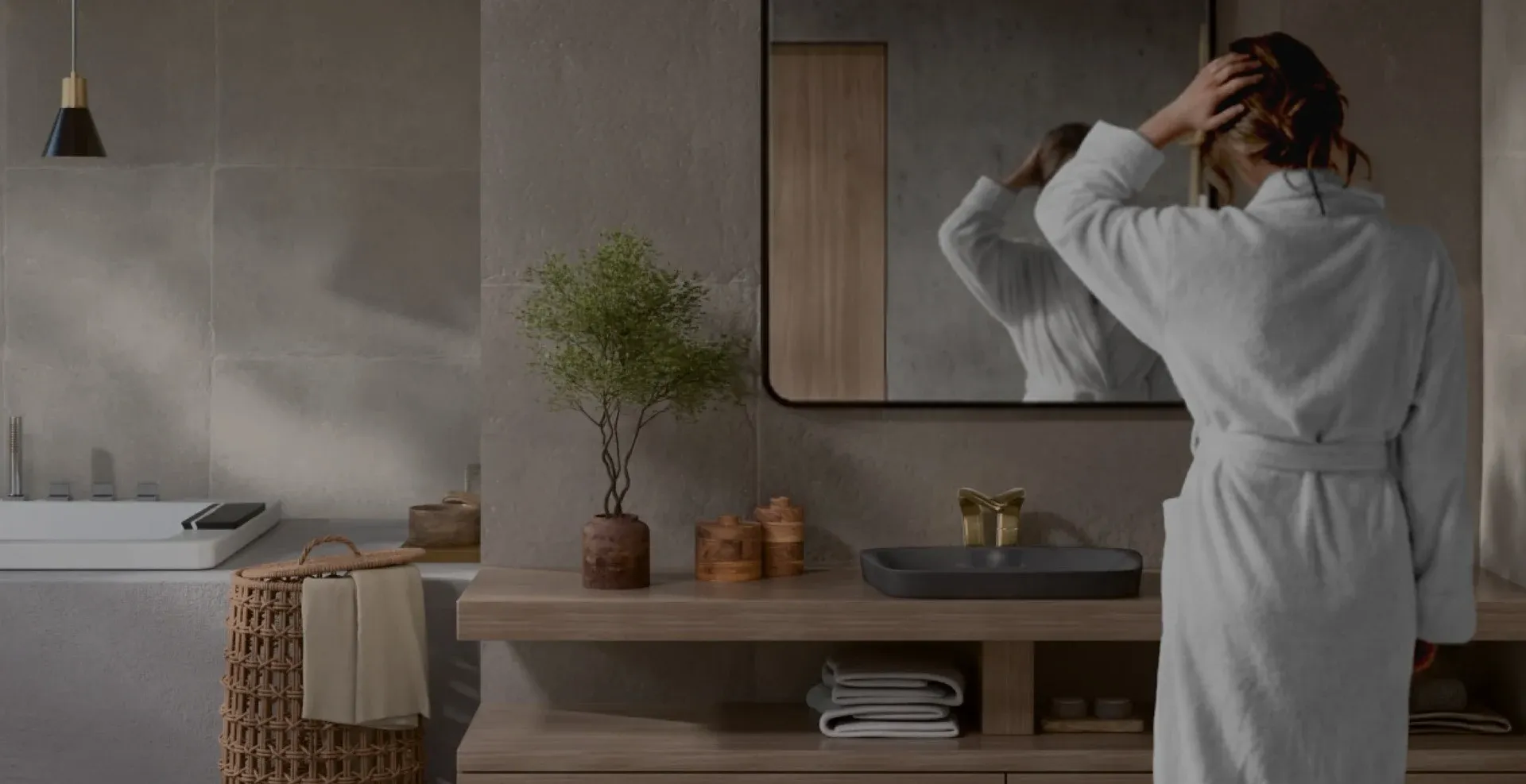
India's bathrooms face pressures that no European or American design guide accounts for. Hard water that deposits white mineral crust on every surface within weeks. Coastal humidity that climbs above 90% for months at a stretch. Water pressure that drops to a trickle at peak hours, then surges without warning. For anyone designing or specifying a luxury bathroom in India, ignoring these realities doesn't just compromise aesthetics - it shortens the lifespan of every fitting, undermines the daily experience, and erodes the investment.
This guide addresses each of these conditions directly, and what a thoughtfully designed luxury bathroom must do about them.
The Invisible Threat in Most Indian Homes: Hard Water
India has one of the most significant hard water challenges in the world. The Bureau of Indian Standards (IS 10500:2012) sets an acceptable total hardness limit of 200 mg/L (as CaCO₃) for potable water, with an upper permissible limit of 600 mg/L. In cities like Delhi, Jaipur, Ahmedabad, and Chennai, unfiltered municipal and borewell supply routinely approaches or exceeds these thresholds.
For a luxury bathroom, this creates a specific and recurring problem. Calcium and magnesium deposits accumulate on basin surfaces, faucet aerators, shower heads, and glass screens. The result is limescale - the chalky white crust that dulls chrome finishes, blocks flow restrictors, and makes even the most refined fitting look neglected after a few weeks of use.
The response to hard water begins at specification, not at the cleaning cupboard. PVD (Physical Vapour Deposition) coatings offer substantially higher resistance to mineral damage than standard chrome plating. Brushed finishes - gunmetal, matte black, brushed gold - trap and show deposits less readily than high-polish chrome, which is perhaps the most common specifier error in Indian luxury bathrooms. Smooth, non-porous ceramic surfaces on wash basins and sanitaryware also reduce mineral adhesion compared to textured or semi-matte alternatives.
At the cartridge level, ceramic disc mechanisms in faucets outperform rubber-washered alternatives in hard water conditions. Ceramic tolerates mineral buildup without losing precision and maintains consistent flow and temperature control over years of daily use.
| Also See: wellness & wash basins |
Humidity, Ventilation, and the Case for Premium Materials
Coastal India - Mumbai, Kochi, Chennai, Thiruvananthapuram - experiences relative humidity consistently above 75%, rising above 90% during monsoon months. Even landlocked metros like Bengaluru and Hyderabad see sustained high-humidity periods between June and October.
In these conditions, material selection is not aesthetic preference. It is structural specification.
Solid brass fittings with corrosion-resistant surface treatments are non-negotiable. For bathroom accessories, stainless steel Grade 304 is the minimum; Grade 316 is appropriate for coastal installations within five kilometres of the sea, where salt air accelerates surface oxidation. Fine Fireclay - the material used in Senator's Ivana collection - offers inherent resistance to moisture penetration and surface degradation that standard vitreous china does not match at equivalent humidity levels. Its denser, less porous structure is a material advantage that compounds over years of use.
Ventilation, though typically left to the architect or MEP consultant, has direct implications for bathware specification. Bathrooms designed with cross-ventilation dramatically reduce moisture load on fittings, mirrors, and wall surfaces. Where natural ventilation is constrained - as it is in most high-rise apartments - exhaust capacity of at least 8 to 10 air changes per hour for the bathroom volume is a baseline for preventing chronic surface moisture damage.
Wall-hung sanitaryware also reduces the contact area between fixtures and moisture-laden floors - a specification choice that is as practical as it is elegant in bathrooms where the floor gets wet as a matter of routine.
Designing Around India's Pressure Reality
Water pressure in Indian residential supply is inherently inconsistent. Buildings with overhead tanks can see pressure as low as 0.5 bar on upper floors. High-rise buildings with booster pumps may experience pressure spikes above 6 bar. Neither extreme is kind to precision bathroom fittings.
Thermostatic shower valves - systems that maintain a set temperature regardless of pressure or flow fluctuations elsewhere in the building - address one of the most persistent friction points in the Indian luxury bathroom experience: the cold water surge mid-shower when another tap opens. For a master bath designed as a wellness sanctuary, a pressure-compensating thermostatic valve is functional infrastructure, not an optional premium.
Pressure-reducing valves (PRVs) at the building entry point protect high-precision fittings - particularly thermostatic cartridges and electronic flush mechanisms - from pressure spikes. Architects and designers specifying luxury bathrooms should confirm PRV installation as part of the MEP scope before finalising fitting selection. Even a finely engineered European-designed faucet will not perform to specification at 8 bar.
For overhead shower systems central to luxury master bath design, a minimum working pressure of 1.5 bar is typically required for adequate flow volume. Where building pressure is insufficient, a dedicated bathroom booster pump is the specification-compliant solution - not a compromise on the shower system itself.
Water Conservation Without Sacrificing the Experience
India is among the world's most water-stressed nations. The World Resources Institute's 2023 Aqueduct Water Risk Atlas rates India as experiencing 'High' to 'Extremely High' baseline water stress across the majority of its geography - a reality that manifests in urban supply restrictions, groundwater depletion, and seasonal rationing in several major cities.
For luxury bathroom design, this creates a genuine tension. The expectation of abundance - rainfall showers, freestanding bathtubs, multi-function body shower systems - set against the arithmetic of scarcity.
Dual-flush cisterns, with a 3-litre partial flush and 6-litre full flush, are now the standard for any well-specified bathroom in India. Flow-regulated aerators have improved significantly; a 6-litre-per-minute regulated flow from a precision aerator is largely indistinguishable in perceived intensity from an unregulated 12-litre flow. The experience is preserved; the consumption is halved.
Freestanding bathtubs - a centrepiece in the wellness bathroom - represent a genuine water consumption consideration. A typical freestanding bath requires 150 to 200 litres per fill. The appropriate design response is not to avoid the bathtub, but to ensure the shower system is specified with equal intent. A wellness bathroom that underspecifies the daily shower in favour of the occasional-use tub is a specification imbalance. Both deserve investment.
Vastu, Spatial Constraints, and the Indian Specification Context
One consideration unique to the Indian luxury segment is Vastu Shastra - the traditional Indian system of spatial design that governs the directional placement of rooms and fixtures. Among affluent homeowners and premium residential developers, Vastu alignment is frequently a specification requirement, not merely a preference.
Standard Vastu guidance places the bathroom in the north, east, or north-east of the home. Within the bathroom, the toilet should ideally face north or south; basins and showers should sit on the east or north wall. These placements influence floor plan decisions that affect fixture positioning, plumbing routing, and the spatial arrangement of the entire bathroom.
For designers specifying luxury bathrooms, understanding Vastu constraints early prevents specification conflicts after construction is underway. A wall-hung toilet that cannot be repositioned after installation creates a different problem than a freestanding bathtub that retains placement flexibility within a room.
Indian urban apartments also trend toward bathrooms that are smaller than European or American equivalents at the same price point. Efficient specification is the answer - wall-hung sanitaryware to maximise floor area, semi-recessed basins where projection depth is constrained, compact enclosures that still deliver a full overhead shower experience. Luxury positioning does not require the square footage of a London townhouse. It requires considered specification.
| Also see: wall-mounted Wash Basins & Hand Showers |
Conclusion
A bathroom designed without accounting for Indian conditions will eventually show it - in the limescale on the fittings, the performance drop in the shower, the surface wear that compromises a space meant to feel enduring. The specifications that resolve these issues are not concessions to practicality. They are what separates bathrooms that age gracefully from those that simply age.
Senator's collections are designed with this understanding - Italian design rigour applied to the conditions of Indian daily life. To discuss specification for your project, connect with our team or visit a Senator Experience Centre near you.


