How Bathroom Design Drives Property Value
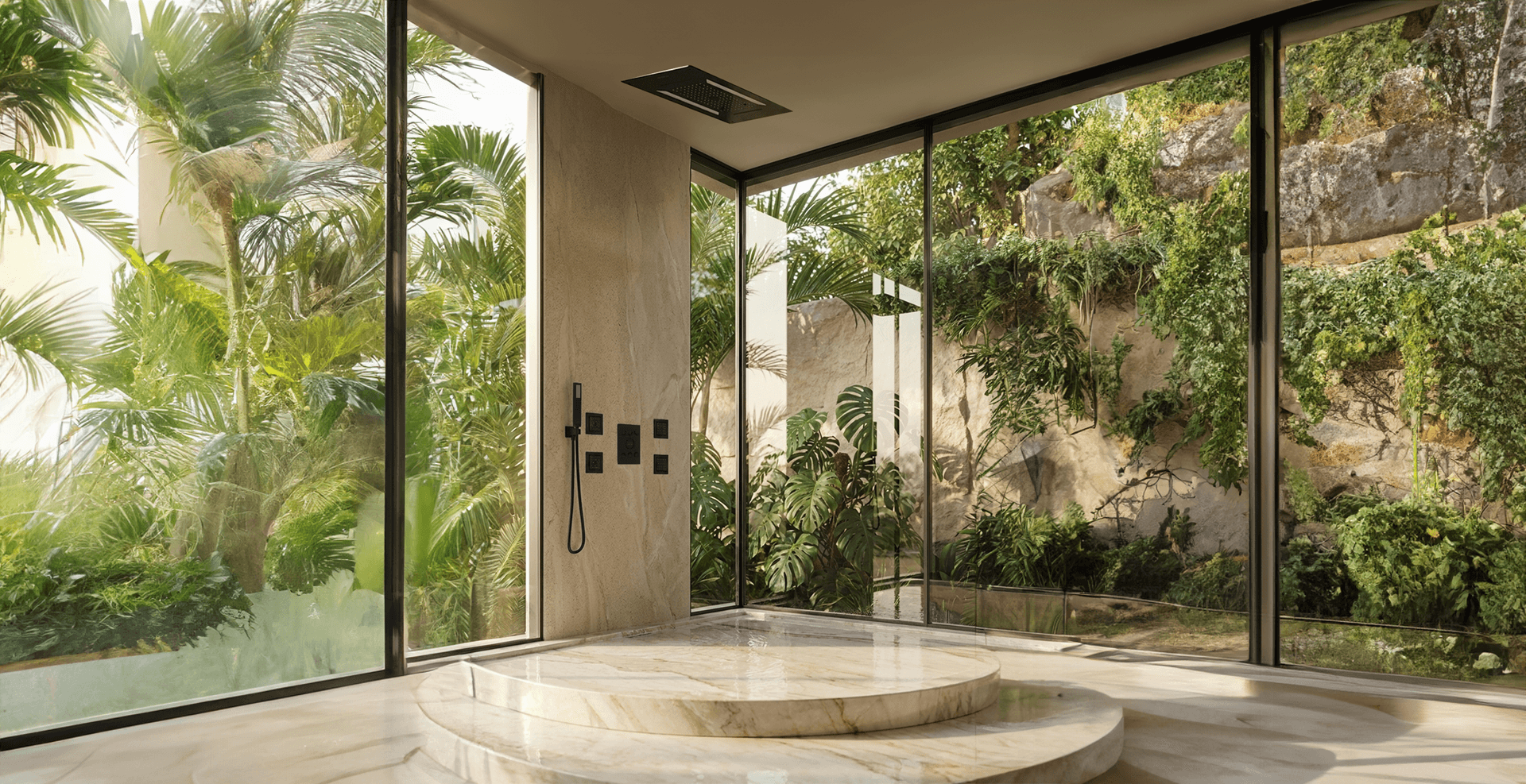
Real estate professionals consistently rank the master bathroom among the top three value drivers in luxury residential property - alongside location and kitchen specification. Yet bathroom investment decisions are often made on instinct rather than strategy. Homeowners renovating premium spaces frequently underestimate how directly bathroom design affects property value, and more critically, how specification quality separates a high-return renovation from one that merely looks expensive.
This is not a guide about fitting a second bathroom. It's about understanding how a deliberately designed, premium-specified bathroom becomes a financial asset - and why the choices made inside it have consequences well beyond the room.
Why Valuers and Buyers Give Bathrooms Disproportionate Weight
The master bathroom holds an asymmetric position in property valuation. In premium residential markets, an outstanding bathroom rarely adds proportionally to the asking price on paper - but a substandard one reliably reduces it. Buyers in the luxury segment use bathrooms as a proxy for the quality of decision-making applied to the entire property. If the material selections feel considered, the proportions deliberate, and the fixtures consistent in their design language, confidence extends naturally to the rest of the home.
According to the Remodeling Magazine Cost vs. Value 2023 Report, upscale bathroom additions in premium markets deliver stronger return multiples than midrange renovations - reflecting the degree to which buyers at the top of the market weight specification quality.
What this means in practice: a bathroom that signals considered thinking adds disproportionate weight in buyer psychology, particularly when buyers are comparing options at comparable price points and similar address credentials.
What "Premium" Actually Signals in a Property Context
The word premium in bathroom design carries a specific meaning in valuation contexts - and it is not synonymous with expensive. A premium bathroom is one where every element is intentional: proportions calibrated to the space, materials chosen for coherence rather than cost alone, and a composition that communicates a single design sensibility rather than a collection of high-ticket purchases assembled independently.
This distinction matters because it determines how buyers - and their valuers - interpret a space. Fixtures that are generically costly but poorly considered read as amateur spending. Fixtures that represent a clear design philosophy, executed with precision, read as architect-level thinking.
In India's growing ultra-premium residential segment - luxury apartments across South Mumbai, Bengaluru's villa developments, and Hyderabad's gated communities - bathrooms with a named design identity are commanding measurably stronger buyer response than those specified purely by finish category.
| Also see: Modern Bathtub & Overhead Shower |
The Design Elements That Carry the Most Valuation Weight
Not every element of a bathroom contributes equally to property value. Research from the annual Houzz & Home Study consistently identifies vanity and basin design, shower and bath specification, and surface material coherence as the primary drivers of perceived renovation quality in premium bathroom projects. Fixture brand recognition follows as a secondary signal in luxury markets.
Translated to a specification context in India's upper residential tier, the highest-impact elements break down as follows.
Basin and vanity design. The wash basin is the first element encountered at close range and the one that dominates listing photography. A designer basin - particularly a sculptural or art-decor form - does disproportionate work in establishing a room's design credentials. Senator's Designer Art Basins and the Ivana series - crafted in Fine Fire Clay with architectural rectangular profiles - demonstrate the kind of design coherence that registers immediately to a trained eye.
Shower specification. A premium shower system - ceiling-mounted, thermostatic-controlled, or column-format - communicates serious investment thinking to buyers who have stayed in luxury hotels or lived in high-specification homes. In India's ₹3 Cr+ residential segment, an overhead shower in a master bathroom is increasingly a baseline expectation, not a feature.
Sanitaryware coherence. The toilet, basin, and supporting sanitaryware should speak the same material and formal language. Mixed specifications - a premium basin paired with standard sanitaryware - undermine the effect of every individual premium piece. Collections designed around a unifying aesthetic, such as Senator's Pure Soft or Ritual series, eliminate this risk by design.
Faucet and tapware. Tapware is handled dozens of times daily. Buyers assess its quality through weight, handle action, and surface finish - immediately, and instinctively. A luxury basin faucet in a considered finish (brushed gold, matte black, polished chrome aligned to the room's palette) functions as a tactile confirmation of everything the bathroom claims to be.
Where the Specification Decision Goes Wrong
The most common error in premium bathroom renovation is prioritising surface materials - large-format marble, book-matched stone feature walls - while under-specifying fixtures. A beautifully tiled bathroom fitted with commodity tapware and generic sanitaryware creates a credibility gap that informed buyers detect immediately. The finish deceives the eye; the fixtures confirm the truth.
The inverse error is less frequent but equally costly: premium-brand fixtures placed in a room without the spatial and material context to support them. A statement freestanding bath in an underdeveloped bathroom reads as a purchase, not a decision.
The correct approach is to establish the design brief first - spatial proportion, material palette, atmospheric intent - and then specify fixtures that serve that brief with precision. This is the logic that underpins how architects working at the top of India's residential market approach specification, and it is the same thinking reflected in Senator's wellness and freestanding bath collections: products designed to function within a composed space, not as isolated centrepieces.
The Compound Effect of Design Provenance
In India's ultra-premium residential market, buyer sophistication is accelerating. A segment that once responded primarily to international brand recognition now increasingly responds to design provenance - named designers, international award recognition, and verifiable craft credentials. This shift has specific implications for specification decisions.
Products with documented design credentials offer a distinct advantage in valuation conversations. The Red Dot Award - among the design industry's most rigorous international distinctions - functions as an independently verified quality signal, recognised by architects, designers, and increasingly by informed buyers. For a homeowner discussing specification with a prospective buyer, being able to reference an award-recognised fixture adds a layer of documented design intent that no amount of surface-level finish can replicate.
Senator Bathware's Visqua Wash Basin, Cosmopolis, and Fluidique faucet each carry Red Dot Award recognition - a direct outcome of the brand's ongoing collaboration with Milan-based designer Ettore Giordano. In a specification conversation, that provenance carries weight that generic luxury finishes simply do not.
| Also see: Facuet & Wash Basin |
Conclusion
Bathroom design has moved from amenity to asset in India's premium residential market. The most important insight isn't that bathrooms add value - it's that specification quality determines by how much. Premium fixtures without design intent underdeliver. Design intent without specification precision does the same. The two have to work together. And that is precisely what separates a bathroom that increases property value from one that merely increases renovation spend. If you are at the specification stage of a luxury bathroom project, explore Senator Bathware's designer collections or speak to our team about the right choices for your space.


