Beyond the Basin: The Evolution of the Designer Vanity
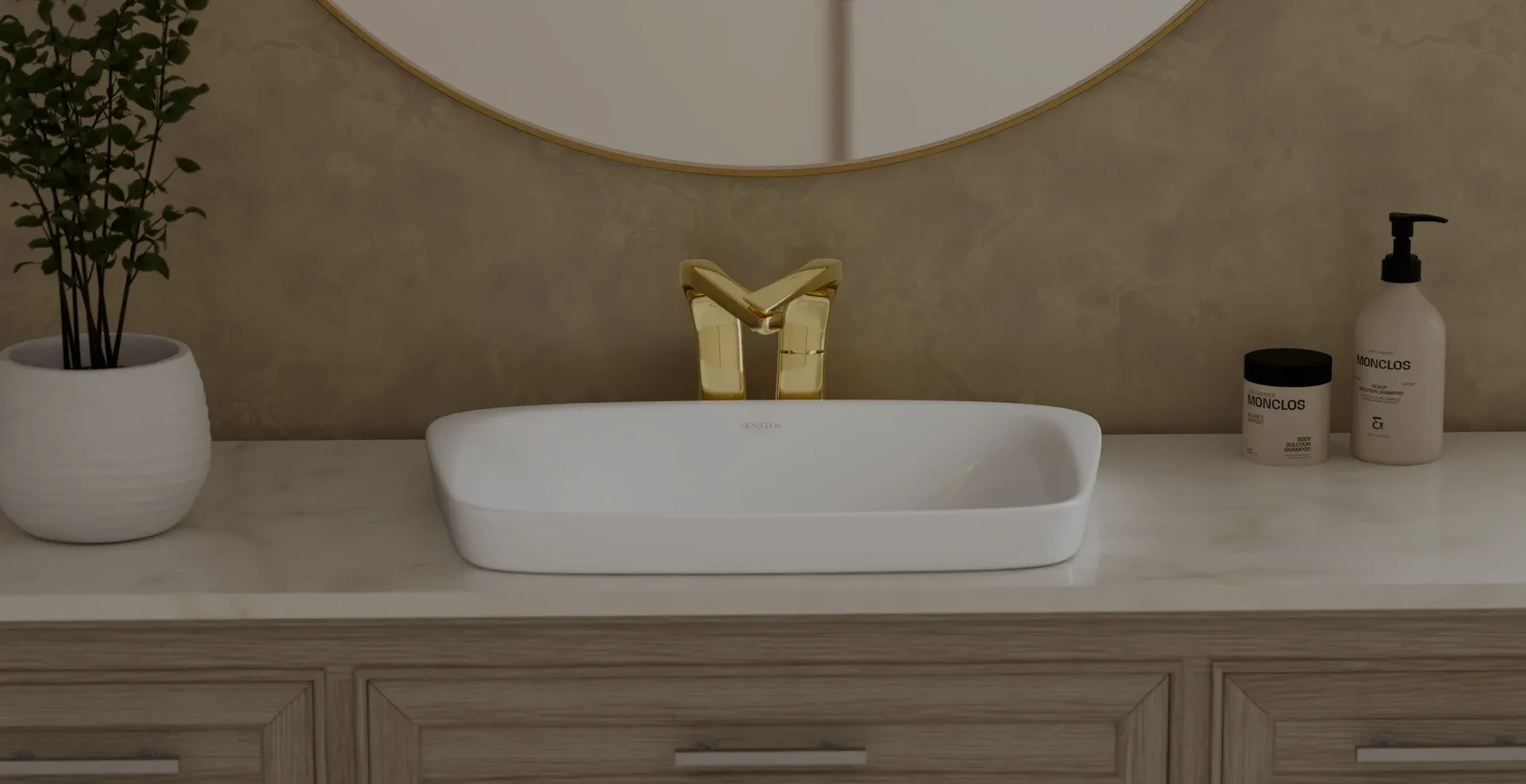
The bathroom vanity has quietly become the most photographed square metre in a luxury home. According to the National Kitchen & Bath Association's 2026 Bath Trends Report, 77% of design professionals now expect homeowners to model their primary bath on a hotel or resort experience - and nowhere is that shift more visible than at the vanity wall. A designer bathroom vanity is no longer a utility fixture tucked against a wall; it's a composed moment of basin, faucet, stone, and light, built to anchor the entire room. For Senator, this is where sculptural form meets everyday ritual - and getting it right starts with how the basin and faucet are chosen together.
The Vanity Wall Becomes the Bathroom's Signature Moment
For most of the last decade, the vanity was an afterthought - a countertop, a mirror, a tap. That's changed. Homeowners walking into a five-star hotel bath now expect the same sense of composed luxury at home, and architects are responding by treating the vanity as a designed object rather than a plumbing requirement.
This is backed by data, not just aesthetics. The NKBA's 2026 report found wood-faced, furniture-style vanities have overtaken painted cabinetry (62% versus 53%), and matte, brushed, and satin faucet finishes now outperform polished chrome across the board. The common thread is intentionality: every surface at the vanity is expected to earn its place, from the basin's silhouette to the faucet's line.
For India's affluent homeowners and the architects specifying for them, this raises the stakes on a decision that used to be routine. The basin is no longer picked last, to fit whatever countertop was chosen - it's picked first, as the piece the rest of the vanity is designed around.
Choosing a Statement Basin from the Designer Art Basins Collection
Industry trade press is tracking the same shift from the manufacturer's side. Kitchen & Bath Design News recently noted that sculptural basins with expressive finishes are becoming genuine focal points in the bathroom, with designers actively seeking forms that reveal their character only from certain angles or in certain light - basins built to be looked at, not just used.
Senator's Designer Art Basins collection was built for exactly this brief. Where a standard basin disappears into the counter, an Art Basin is meant to hold its own - a sculptural form that reads as an object first and a fixture second. When selecting from the range, three questions do most of the work:
-
What does the room see first? In a large master bath, a bold, irregular silhouette carries the room. In a smaller powder room, a cleaner geometric form avoids visual clutter while still reading as designer.
-
Countertop or table-top mount? A table-top basin sits proud of the counter and amplifies its sculptural presence - the stronger choice when the basin is meant to be the room's centrepiece.
-
What finish carries the rest of the palette? Matte and stone-textured finishes are pulling ahead of high-gloss white, echoing the broader move toward tactile, honed surfaces across luxury bath design.
Pair the chosen basin with the Symmetry or Origami collections when the brief calls for a coordinated vanity-to-shower language, rather than treating the basin as an isolated selection. | Also See: Table top basin & Designer Art Decor Basins |
Pairing the Basin: Expression or Fluidique
A striking basin loses impact if the faucet fights it. This is where most vanity briefs go wrong - the basin gets the attention, and the faucet is an afterthought. At Senator, Expression and Fluidique are the two most natural pairings for a Designer Art Basin, and they solve different problems.
Expression draws on a heart-shaped, sanctuary-inspired design language - soft, continuous curves that echo a rounded or oval basin form. It suits vanities built around warmth and comfort: a spa-adjacent primary bath, a wellness-led project, a basin with organic, unbroken lines. Choosing Expression alongside a curved Art Basin keeps the whole vanity reading as one considered gesture rather than two separate decisions.
Fluidique, by contrast, is built on precision - a single-lever form with a tighter, more architectural silhouette. It's the stronger match for angular or geometric basins, or for a vanity where the brief calls for restraint over softness. In a project with strong horizontal lines - large-format stone, a floating vanity shelf, a minimal mirror - Fluidique keeps the faucet from competing with the basin's shape.
The working rule for architects: match curve to curve, angle to angle. A rounded Art Basin with Fluidique's sharper geometry can work, but only when the rest of the vanity - countertop edge, mirror frame, cabinetry pulls - deliberately bridges the two languages. Left unplanned, it reads as mismatched rather than eclectic.
Composing the Full Vanity: Countertop, Mirror, Lighting
Basin and faucet set the tone, but the vanity is judged as a whole composition. The current material story, as reported by ARIEL Bath's 2026 vanity trend coverage, leans firmly toward natural and engineered stone countertops - Italian Carrara-style marble in particular - paired with undermount or table-top basins that create a continuous, spa-like surface.
For a Senator vanity, this translates into a few working principles:
-
Let the basin be the only sculptural element. If the Art Basin is doing the visual work, keep the countertop material calm - a honed stone with restrained veining rather than a competing pattern.
-
Mirror and lighting should frame, not distract. A clean-lined mirror with integrated edge lighting draws attention back to the basin and faucet rather than pulling focus toward the wall.
-
Storage stays furniture-grade. Floating cabinetry in a warm wood finish, soft-close drawers, and minimal visible hardware are now the baseline expectation at this price point, not a premium add-on.
This is also where the Cosmopolis and Visqua award-winning pieces earn their place in a specification conversation - both were designed as anchor points for exactly this kind of composed vanity, and referencing their Red Dot recognition gives architects a credible design story to bring to clients.
Practical Tips for Specifying a Designer Vanity
For architects and interior designers working from a brief, a few sequencing decisions make the difference between a coordinated vanity and a collection of good individual pieces:
-
Select the basin before the countertop material. The basin's form should dictate the counter's restraint or richness - not the other way round.
-
Confirm faucet-to-basin proportion early. Expression and Fluidique both have multiple configurations; a basin's rim height and mounting depth need to be checked against the specific faucet model, not the collection name alone.
-
Treat the vanity wall as one sightline. Basin, faucet, mirror, and lighting should be reviewed together as a single elevation drawing, not approved fixture-by-fixture.
-
Bring hospitality references into the client conversation. Given how strongly homeowners are now benchmarking against hotel bathrooms, a short mood board referencing that language tends to align expectations faster than a spec sheet alone. | Also See: Faucets & Luxury wash basin |
Frequently Asked Questions
Q: Should the basin or the faucet be selected first in a designer vanity?
A: Start with the basin. Its form and mounting style set the geometry for everything else - faucet, countertop, and mirror should all be chosen to complement it, not the reverse.
Q: Is Expression or Fluidique better for a small powder room vanity?
A: Fluidique's tighter, single-lever form suits compact vanities well, since its architectural lines don't visually crowd a smaller basin the way a softer, curved faucet can.
Q: Do Designer Art Basins work with standard countertop depths?
A: Table-top mounted Art Basins generally need a deeper counter than undermount styles to sit proud without overhang risk - confirm mounting depth against the specific basin model before finalising cabinetry.
Q: What finish pairing works best for a warm, spa-like vanity?
A: Matte or brushed finishes on both basin and faucet reinforce the tactile, honed-stone look currently leading luxury bath design, rather than mixing matte basin with a polished faucet.
Conclusion
The designer vanity has moved from an assembly of parts to a single composed statement - and that shift rewards choosing basin and faucet together rather than in sequence. Senator's Designer Art Basins, paired deliberately with either Expression's soft curves or Fluidique's architectural precision, give architects and homeowners a way to build that composed vanity wall without guesswork. For a project-specific pairing recommendation, enquire with the Senator team or explore the full range in the Designer Art Basins collection.


