The Sculptural Bath: Embracing the Origami & Ritual Collections
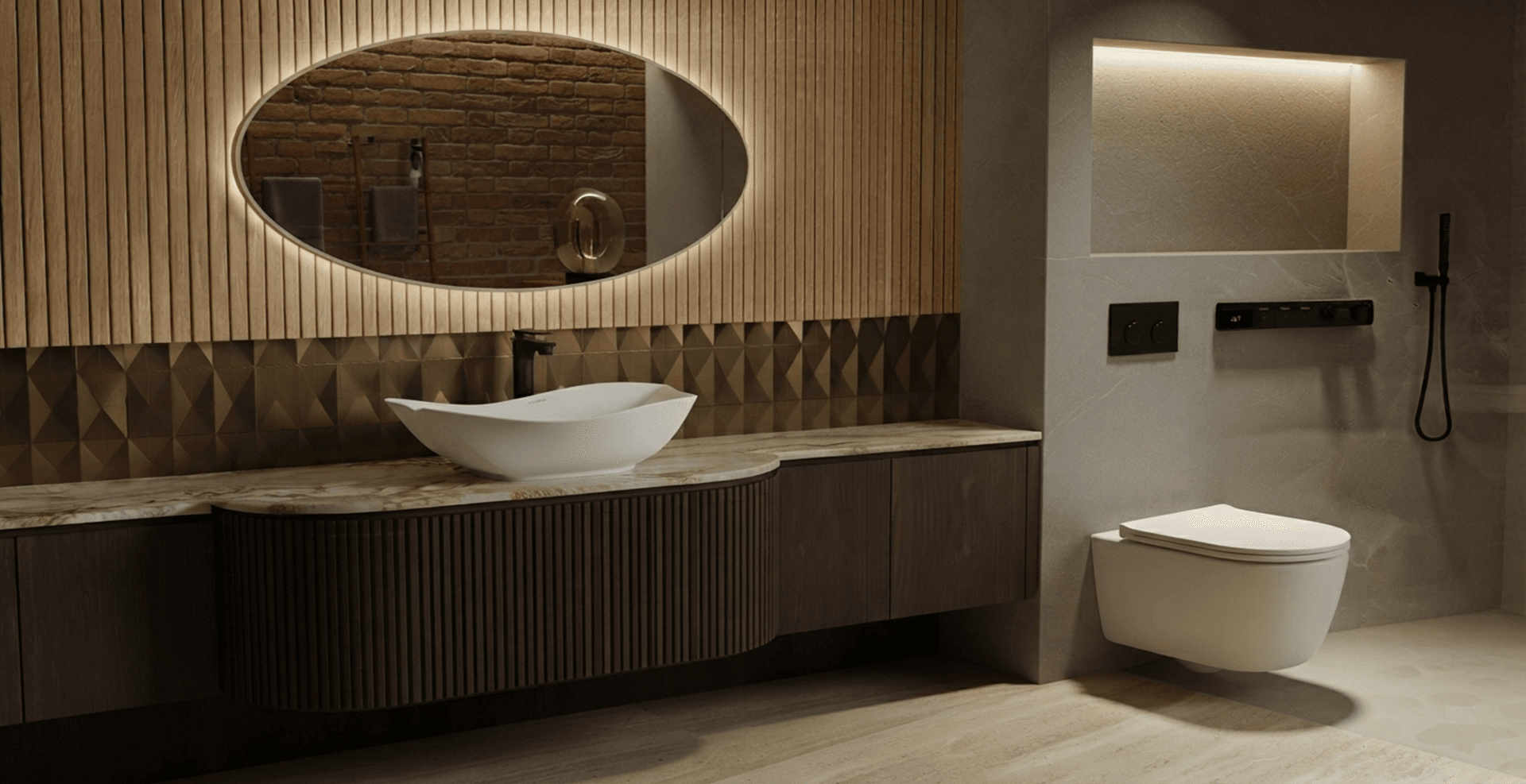
Most bathware is designed to disappear - functional, forgettable, chosen to blend in rather than stand out. Senator's Origami and Ritual collections take the opposite position. Here, geometry is not decoration applied after the fact; it is the design brief itself. Every plane, fold, and edge is engineered to hold water, resist wear, and still read as a considered object - functional art, not furniture that happens to work.
This is the idea behind the sculptural bath: a bathroom where the basin, the tub filler, and the shower column carry the same intentionality as a piece placed in a gallery, curated under the design direction of Milan-based, Red Dot Award-winning designer Ettore Giordano.
What you'll find in this guide:
- The design language behind the Origami and Ritual collections
- Why geometric restraint is harder - and more valuable - than ornamentation
- How to build a cohesive sculptural bathroom around these two collections
Why Most Bathware Isn't Designed to Be Looked At
Walk through a typical bathroom showroom and the language is almost entirely about performance: flow rate, flush efficiency, water-saving certification. These are necessary conversations, but they rarely intersect with a second, equally important question - what does the object communicate when no one is using it?
In luxury residential and hospitality design, the bathroom has shifted from a utility room to a considered space, often the most personal room in a home. Architects and interior designers now specify bathware the way they specify furniture: for proportion, material honesty, and how a form behaves in natural light. A basin with a genuinely sculptural silhouette does something a purely functional one cannot - it holds attention.
This is the gap the Origami and Ritual collections were built to close. Both start from the same premise: that geometry, treated with discipline, is enough. Neither collection relies on surface ornament, color contrast, or applied pattern to make its case. The form is the statement.
The Origami Collection: Geometry as Discipline
The name signals the intent directly. Origami takes its cue from the folded plane - the idea that a single continuous surface, creased and angled with precision, can hold complexity without adding a single unnecessary line. In basin and sanitaryware design, this translates into crisp, faceted edges and flat planes that catch light differently depending on the angle of view, giving the piece a quality closer to cut stone than cast ceramic.
The design logic here rewards restraint. There is no embellishment layered onto the form because the form itself is the argument - balance achieved through the relationship between flat surface and sharp edge, rather than through decoration. It is a deliberately quiet kind of confidence, closer to how a well-tailored piece of furniture reads in a room: precise, considered, and entirely unbothered by trend cycles.
For architects specifying for high-end residential or branded hospitality projects, this matters practically as much as aesthetically. Faceted, geometric forms photograph well under directional lighting, hold their visual identity across different tile and stone backdrops, and age without looking dated - a genuine advantage over more ornamental sanitaryware ranges that can feel era-specific within a decade.
The Ritual Collection: Sculptural Form, Everyday Function
Where Origami works in planes, Ritual works in mass and volume - solid, considered forms that read as objects in their own right rather than fixtures fitted into a wall. The collection's premise is in its name: bathing as a considered daily practice rather than a task to move through, and bathware that supports that pace rather than working against it.
This is where the "functional art" idea is easiest to see in practice. A Ritual piece placed in a bathroom does the job any basin or fitting must do - but its presence in the room doesn't end there. The rounded, deliberate volumes create a visual anchor, the kind of piece an architect will build a room's material palette around, rather than slot in at the end of a project.
It's a useful contrast to Origami's faceted precision: two different sculptural vocabularies, both curated under the same Italian design direction, both eligible to sit in the same home without competing. That range - sharp geometry on one end, considered mass on the other - is precisely what gives a designer room to work with client taste rather than defaulting to a single "look."
Functional Art: What the Term Actually Means Here
"Functional art" gets used loosely in interior design marketing, often to justify a price point rather than describe an actual design principle. It's worth being precise about what it means in the context of Origami and Ritual.
An object qualifies as functional art when its aesthetic decisions are inseparable from its performance - not applied to it. A folded basin edge in the Origami collection isn't a stylistic flourish bolted onto a standard bowl; the fold is how the piece achieves its silhouette while still holding water correctly. A rounded Ritual volume isn't softened for softness's sake; the mass is what gives the piece its physical presence in a room at a scale a flat fixture couldn't match.
This is also where Ettore Giordano's design heritage becomes relevant beyond a credentials line. Red Dot Award recognition - the same jury that has evaluated products like the Visqua Wash Basin, Cosmopolis, and Fluidique - specifically rewards design where form and function are resolved together, not negotiated as a trade-off. Origami and Ritual sit in that same design lineage: pieces judged on whether the geometry earns its place, not on how much surface decoration was applied.
For design-literate buyers - and the architects specifying on their behalf - this distinction is not academic. It is the difference between a bathroom that reads as assembled and one that reads as curated.
Curating a Sculptural Bath: Where to Start
Building a bathroom around sculptural bathware doesn't mean filling the room with statement pieces. Restraint applies to the room the same way it applies to the objects in it.
Choose one hero piece per zone. A single Origami basin or Ritual freestanding tub carries more visual weight than several competing geometric pieces in the same sightline. Let one collection lead the room; use the second, if at all, in a secondary zone like a powder room or guest bath.
Let material finish do the supporting work. Because both collections rely on form rather than surface pattern, the surrounding materials - stone countertops, matte tile, warm metal fixtures - carry more of the room's tonal story. Keep backgrounds quiet so the geometry stays legible.
Think about light direction before installation. Faceted Origami surfaces and rounded Ritual volumes both respond dramatically to directional lighting. A basin that looks flat under diffuse overhead light can look genuinely sculptural under a single well-placed downlight or window.
Specify early, not as an afterthought. Architects working on high-end residential or hospitality projects get the most value from Origami and Ritual when the pieces are part of the initial spatial plan - sized, lit, and positioned as design elements - rather than selected off a fixture schedule at the end of a project.
Buyers and specifiers working through these decisions can review the full collection details or begin a project conversation directly through Senator's product enquiry page.
Frequently Asked Questions
Q: What's the design difference between the Origami and Ritual collections?
A: Origami is built on faceted, folded planes and sharp geometric edges. Ritual is built on rounded, solid volumes. Both are sculptural rather than ornamental, but they express that through opposite design vocabularies - precision versus mass.
Q: Can Origami and Ritual pieces be mixed in the same bathroom?
A: They can, but it's generally stronger design practice to let one collection lead a given room and use the second in a separate zone, so the two geometric languages don't compete for attention in the same sightline.
Q: Who designed the Origami and Ritual collections? A: Both collections were curated under the design direction of Ettore Giordano, the Milan-based, Red Dot Award-winning designer behind Senator's broader product curation, including award-winning pieces like the Visqua Wash Basin.
Q: Are sculptural, geometry-led bathware pieces harder to specify for architects?
A: Not inherently - but they reward earlier specification. Because the form is the design statement, lighting, surrounding materials, and placement matter more than with a standard fixture, so involving these pieces at the design stage rather than the finishing stage gets the best result.
Q: Is "functional art" just a marketing term, or does it describe something real?
A: In this context it describes pieces where the aesthetic form and the functional performance are resolved as a single design decision, rather than styling added after an engineering brief is finished - the same standard Red Dot Award judging applies to recognized design work.


